
geomermaids · GeoParquet
Open geospatial datasets in GeoParquet 2.0, free to use and queryable straight from a URL. No account, no key, no download step: your query engine reads only the columns and row groups it needs, over plain HTTPS.
Or ask an AI agent: the parquetry skill turns a spatial question into the query over these files and answers with the numbers, definitions and credits. Install it in Claude Code ↓
The datasets
All in one bucket, parquetry.geomermaids.com. Each dataset has its own folder, licence and ATTRIBUTION.txt, and every file has a bbox column, so spatial filters skip row groups on all of them.
OpenStreetMap, North America
The US, Canada and Mexico: 98 states and provinces, 16 themes each (buildings, roads, POIs, water...). Rebuilt daily, dated snapshots kept.
GMWID, World Infrastructures
Power, telecoms, oil and gas, water, worldwide: OpenStreetMap's infrastructure, measured against and completed from authoritative open sources, with voltages in kV and outputs in MW. One file per layer.
FAO GAUL 2024
Global administrative units: 3,110 first-level and 45,524 second-level units, plus a country layer dissolved here from level 1. Whole world, or one folder per country, and PMTiles for web maps.
Corine Land Cover 2018
Europe's land cover: 2.4 million polygons with their CLC class, area and country, in one file for Europe and one per country (country=FR/). EPSG:3035, not lon/lat: reproject before joining with the others. PMTiles in the official CLC colours for web maps.
FEMA National Flood Hazard Layer
US flood zones from 2,502 county deliveries in the 50 states and Puerto Rico: 5.8 million zones with their FEMA zone, subtype and base flood elevation, cut into 95.6 million pieces of at most 100 vertices for fast point lookups. One file per FEMA county delivery (state=LA/22071C.parquet) and an index of them (counties.parquet), updated daily as FEMA republishes. Not for official flood determinations.
Geoconnex, US water features
The Internet of Water's reference features for US water data: 852,673 rivers from head to outlet, linked into a network, 98,534 dams, 203,525 stream gages, watersheds HU02 to HU12 and aquifers. Plus 4.6 million water monitoring sites (Water Quality Portal, USGS), each with a URI that leads to its data. One file per layer or source, checked weekly.
US Census TIGER/Line
The Census Bureau's boundaries, one GeoParquet file per layer with its TIGER columns unchanged, starting with the districts of the November 2026 elections: the 435 congressional districts of the 120th Congress and every state legislative district, upper and lower. PMTiles beside each file.
Browse and preview
- File Explorer. Walk the bucket in a browser, folder by folder, with sizes and dates. Click a
.parquetto download it, or its view link to see it on a map. Command-line tools (DuckDB,curl,rclone) still get the raw bytes. - Map viewer. Opens any file of the bucket in your browser. DuckDB-WASM streams only the row groups under the viewport.
- GeoPQ Workbench. Our free desktop app for macOS, Windows and Linux. Every dataset here is built in: pick a country or a state and its layers load straight from the bucket.
Or build an OpenStreetMap URL here:
…
s3.geomermaids.com (path-style, anonymous reads)Query it
With DuckDB, a file is a table. Counting the buildings of Midtown Manhattan reads a few row groups of a 335 MB file:
INSTALL httpfs; LOAD httpfs; INSTALL spatial; LOAD spatial;

SELECT count(*) AS buildings
FROM read_parquet('https://parquetry.geomermaids.com/osm/latest/country=US/state=US-NY/buildings.parquet')
WHERE bbox.xmin <= -73.98 AND bbox.xmax >= -73.99
AND bbox.ymin <= 40.76 AND bbox.ymax >= 40.75;More in the Querying Parquetry cookbook: spatial joins, nearest features, whole-continent queries through our anonymous S3 endpoint, GeoPandas and QGIS. New to DuckDB? Start with the Reading cookbook.
Ask an AI agent
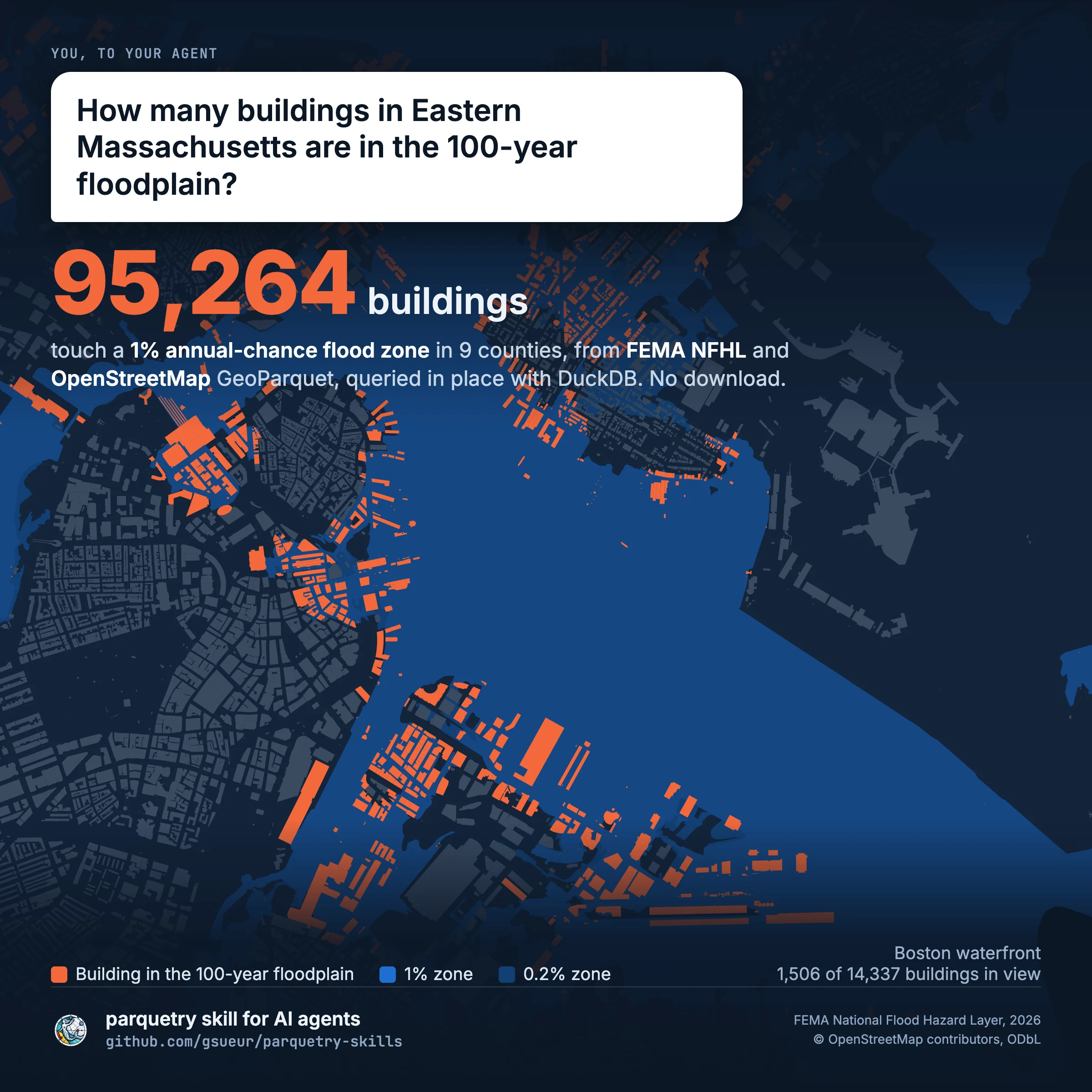
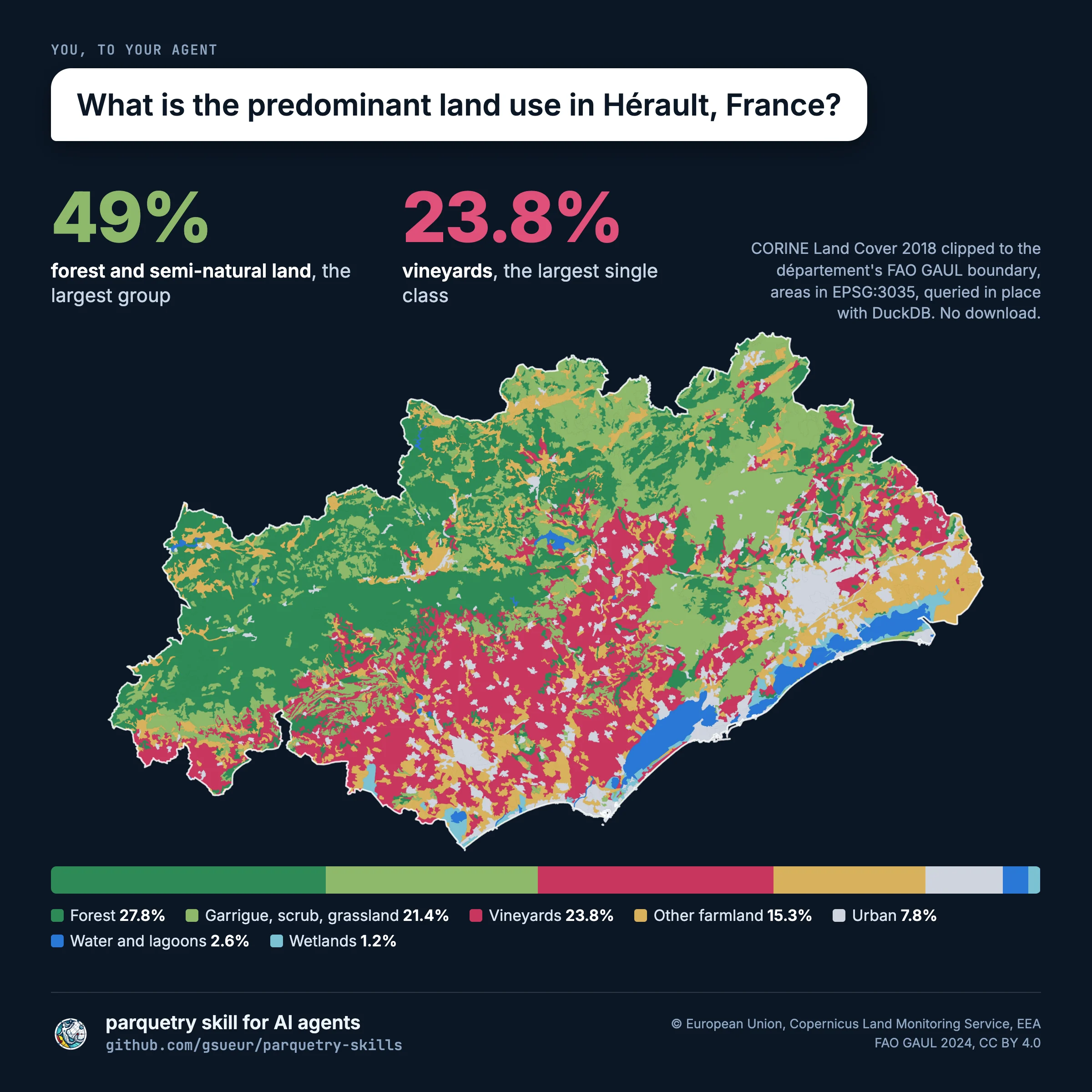
The parquetry skill lets an AI agent answer spatial questions by combining these datasets: What is the predominant land use in Hérault? How many buildings in Eastern Massachusetts are in the 100-year floodplain? Which substations are within 5 km of this site? Which dams are on the Colorado and its tributaries? The agent writes and runs the DuckDB query, then answers with the definitions it chose, the coverage gaps, the data dates and the credits. In Claude Code:
/plugin marketplace add gsueur/parquetry-skills
/plugin install parquetry@geomermaidsThe skill is plain Markdown with tested queries, so any agent that can run DuckDB can use it. Two answers it gave, mapped from the same files:
OpenStreetMap, North America
98 regions: the 50 US states, the District of Columbia, Puerto Rico and the US Virgin Islands; Canada's 10 provinces and 3 territories; Mexico's 31 states and Ciudad de México. Built every day from Geofabrik's regional extracts.
Themes
Each region has 16 files, one per theme, with typed columns promoted from OSM tags. Every file also keeps the full OSM tags as a MAP(VARCHAR, VARCHAR): anything not promoted is a tags['key'] lookup away.
| theme | geometry | typed columns (excerpt) |
|---|---|---|
buildings | polygon | building, name, levels, height, addr_* |
roads | linestring | highway, ref, oneway, surface, maxspeed, lanes |
railways | point, linestring | railway, name, operator, gauge, electrified |
waterways | linestring | waterway, name, width, intermittent, tunnel |
water | polygon | water, natural, name, intermittent, salt |
landuse | polygon | landuse, name, operator |
natural_ | polygon | natural, name, wetland |
natural_ | point | natural, name, ele, prominence |
places | point | place, name, population, admin_level, capital |
boundaries | polygon | boundary, admin_level, name, iso3166_* |
pois | point | amenity, shop, tourism, leisure, office, healthcare |
amenities_ | polygon | amenity, shop, tourism, leisure, brand |
power | point, linestring, polygon | power, name, voltage, voltages, frequency, operator, cables |
aeroways | point, linestring, polygon | aeroway, name, iata, icao, ref, surface |
barriers | point, linestring | barrier, name, access, height, material |
public_ | point | public_transport, highway, railway, name, operator |
URLs and snapshots
https://parquetry.geomermaids.com/osm/<YYYY-MM-DD | latest>/country=<CC>/state=<ISO 3166-2>/<theme>.parquet

# e.g. every building in New York State, today
https://parquetry.geomermaids.com/osm/latest/country=US/state=US-NY/buildings.parquet
Dated snapshots never change, so a pinned date gives the same answer next year. We keep every day for 14 days, then the first of each month for a year, then December 31 of each year for good. snapshots.json lists what is available. Need a date kept? Ask us.
Inside each file
- Native Parquet
GEOMETRYtype, GeoParquet 2.0, with geospatial statistics per row group. - A
bboxcolumn, so engines that don't understandGEOMETRY(Spark, Trino, polars) can still skip row groups on a bounding box. - Rows in Hilbert order, so a bounding-box query reads a few neighbouring row groups instead of the whole file.
- Bloom filters on the typed columns and on
tags: a lookup such asname = 'Central Park'skips every row group that cannot hold it.
Built with osmium-tool and DuckDB, and validated every night before it is published; the files pass gpio check. The pipeline is open source (MIT): github.com/gsueur/osm-geoparquet.
STAC catalog
A Portolan (STAC) catalog describes each theme: columns, extents, row counts, and a glob that reads every region at once. osm/catalog/catalog.json follows latest/; osm/catalog/<date>/catalog.json pins a kept snapshot. It is listed in the Portolan registry and opens in the STAC browser. GAUL has its own: gaul/catalog/catalog.json.
How it compares
Geofabrik is our upstream: their daily regional extracts, in PBF, Shapefile and GeoPackage, are what we start from. Overture Maps publishes worldwide GeoParquet every month, merging OSM with other sources under its own schema. We keep OSM's own tags, publish daily, and split by state so one URL is one manageable file.
GMWID, GeoMermaids World Infrastructures Dataset
Where OpenStreetMap falls short, authoritative open sources complete it: every row says where it comes from, and every build publishes how OSM compares with each source. Sources, licences and coverage: gmwid.geomermaids.com.
The base is the content of Open Infrastructure Map, as GeoParquet: power lines, circuits, substations, plants and generators; telecom cables, masts and data centres; pipelines, wells and platforms; water works. Voltages are parsed to kV per circuit, outputs to MW, and plants and substations are assembled from their OSM relations. 27 layers, each with the full OSM tags.
https://parquetry.geomermaids.com/gmwid/latest/<layer>.parquet

# e.g. every power line on the planet
https://parquetry.geomermaids.com/gmwid/latest/power_line.parquet
One file per layer for the whole planet, Hilbert-sorted, so a query skips most of it: a bbox filter reads only the row groups it touches, and a filter on the country and state columns every row carries skips most of the rest.
SELECT voltage_kv, count(*) AS lines, round(sum(length_km)) AS km
FROM read_parquet('https://parquetry.geomermaids.com/gmwid/latest/power_line.parquet')
WHERE country = 'DE' AND state = 'bayern' AND voltage_kv >= 220
GROUP BY 1 ORDER BY 1 DESC;States are the GAUL first-level units as name slugs (texas, bayern); offshore features have state = '_offshore'. Built weekly from Geofabrik's continental extracts. Only the latest build is kept.
Other regions, schemas or hosting
What is here is built one way for everyone. We also build:
- other regions: Europe, one country, your own polygon;
- other themes, or more columns promoted from OSM tags;
- your own cadence, up to hourly;
- hosting with freshness and availability guarantees, or delivery to your own bucket.
Get in touch: contact@geomermaids.com